
You Changed the Policy. Did Your Support Team?
A policy change reaches customers when every saved reply, help article, and email says the new rule. What customer service needs from you, and what to ask.

Picture a home-goods store that stops paying for return shipping, so the cost of the return label now comes out of the refund. The owner updates the returns page the same day and tells support.
Weeks later, a customer disputes the deduction and forwards the owner the reply one of the store’s agents sent. It promises a free return label. The agent used the saved reply for returns, which nobody had rewritten, and the store’s order confirmation email still says free returns as well.
A policy change is finished when every place your support answers from says the new thing, someone owns making that happen, and you’ve decided what happens to customers who bought under the old rule. Updating the page and telling the team is where the change starts.
What Has to Change When You Change a Return Policy
The returns page is the version of the policy you edited. Your support team answers from several others, and each one keeps saying what it said until someone edits it.
Saved replies and macros are usually where most copies of the policy sit. Other help articles mention the policy in passing, such as the shipping page or the article on damaged items. Any order, shipping, or returns email that mentions the policy sends it automatically to each customer who gets one.
If an AI assistant drafts or sends answers, it reads from your help content. Then there’s what each agent remembers from training. For commercial customers, the policy also lives in the terms on each customer’s record.
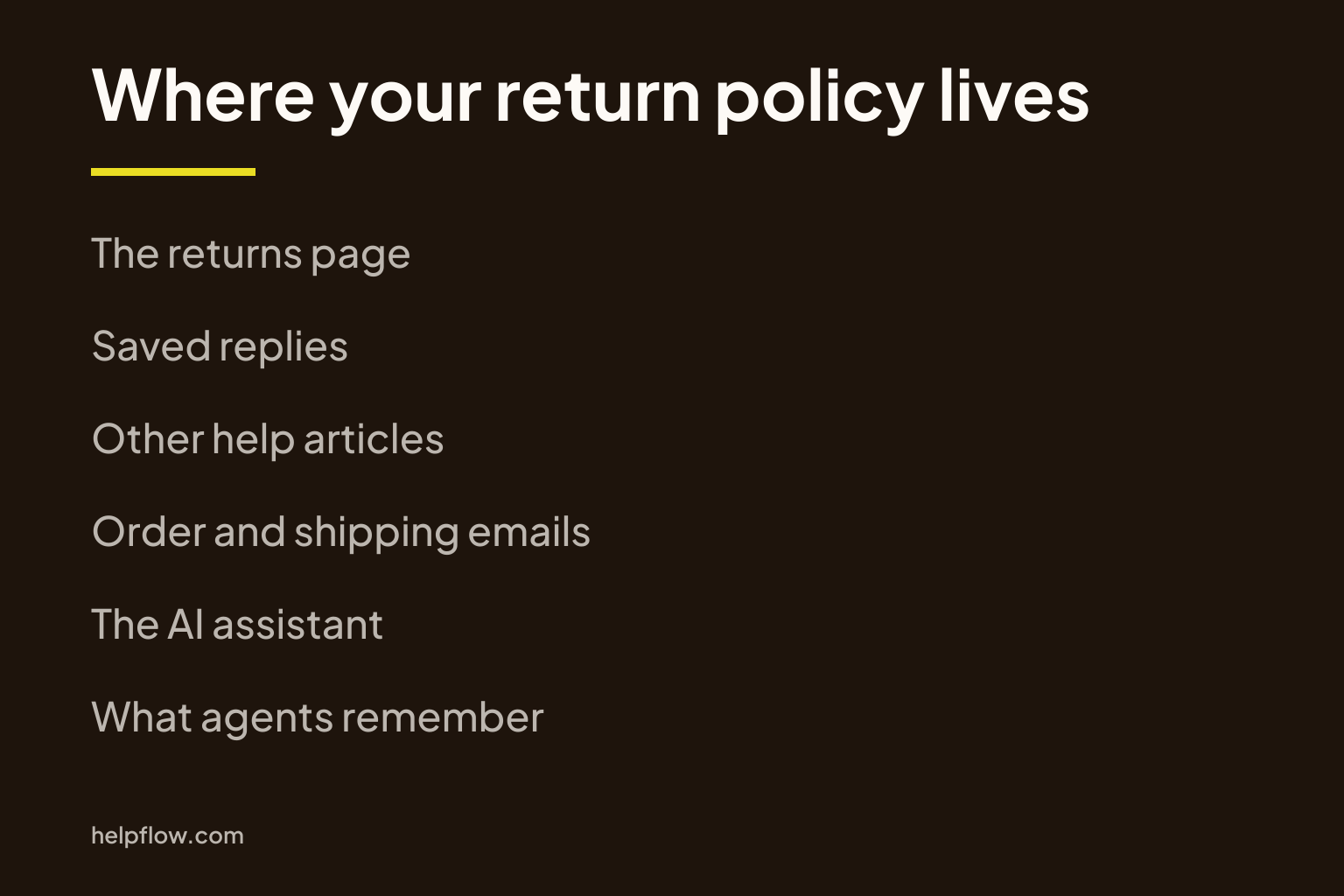
The returns page is the only one of those that changed the day you made the decision. The rest still carry the old policy until somebody finds them and rewrites them.
What Support Tells Customers Is Your Policy
Your agents answer from what’s already written. An agent with a queue in front of them uses the saved reply for returns when a customer asks about returns. If nobody rewrote it, the old policy goes out under your name, from an agent who is doing the job the way they were trained.
The same applies to what agents remember from training and from old tickets. An agent who learned the old rule keeps applying it until someone tells them what changed and why.
To the customer, what support told them in writing is your policy. They quote it back to you, sometimes with a screenshot. You then either honor the old terms or argue with a customer who is holding your own email.
A Canadian tribunal took the same view of an airline’s website. In Moffatt v. Air Canada, British Columbia’s Civil Resolution Tribunal held the airline to what its website chatbot had told a customer about bereavement fares. The tribunal wrote: “It should be obvious to Air Canada that it is responsible for all the information on its website. It makes no difference whether the information comes from a static page or a chatbot.”
That was one small-claims decision about one airline in British Columbia. Your customer reads your agent’s reply the same way, as the company speaking.
An AI assistant that drafts or sends answers from your help content reads the same pages your agents do. It quotes an outdated article as readily as a current one, and it can repeat that article to every customer who asks. Updating the content it reads is part of the change.
When a Policy Change Is Finished
Telling the team starts a policy change. On the support side, the change is finished when every reply, article, and email says the new thing and agents have been told what changed and why.
Finding every place starts with a search. Whoever runs support searches the saved replies, help articles, and email templates for the old rule’s wording and rewrites each one they find. For the home-goods store, the search terms are “free returns” and “prepaid label.” Every rewritten item then carries a new edit date, which is how anyone can check the work later.
Agents need the reason as well as the new rule. An agent who knows why the label now comes out of the refund can explain it to a customer who pushes back on the deduction. An agent who only has the new reply can send it, and has nothing to add when the customer argues.
Someone then reads the first tickets on the subject after the change, to see what customers are actually being told. Reading the first tickets after a change is a QA job, and it catches whatever the rewrite missed. A few recent tickets on the subject, as they were sent, tell you more than anyone’s assurance that the team knows.
Each of those steps is work, and the change needs an owner. In our view, the owner is whoever runs the operation, whether your support sits in-house or with a provider.
An in-house lead who also carries the queue rarely has the time to find and rewrite every reply that mentions a policy. A provider that supplies agents passes your message on to them. A provider that runs the operation owns the change across every place the policy lives.
Operational change is one of the jobs that should sit with whoever runs your support rather than drift back to you.
The Rule Only You Can Make
Your part in a policy change is small and specific. You decide the policy and when it starts, and you decide what happens to customers who bought before it. Finding and rewriting the replies belongs to whoever runs your support.
That last decision is the transition rule, and agents can’t make it for you. A customer who ordered just before the change and sends the item back just after it is in a gap your new policy doesn’t cover.

Without the rule, each agent improvises. Customers in the same position get different answers, and whichever answer goes out becomes the policy that customer quotes back to you.
The transition rule belongs in the change itself. Write it down before the new page goes live, in words an agent can apply to a ticket.
A usable rule names the date that decides it, such as the order date or the delivery date, and says which policy applies on each side of it. “Orders placed before the change keep free returns” is a rule an agent can apply. “Use your judgment” is how customers in the same position end up with different answers.
Commercial Customers Make the Change Harder
All of this holds whether you sell to consumers or to other businesses, and the commercial case is harder. A change to a price tier, a freight minimum, a lead time, or payment terms may apply to some customers and leave others on their existing terms. Agents have to know which customer is on which.
Picture a supplier of commercial kitchen equipment that lengthens the lead time on one product line. The product page changes, and the sales team is told. A saved reply still quotes the old lead time, and a restaurant books its fit-out around it. When the equipment arrives late, the opening date moves with it, and the email that set the date came from the supplier’s support team.
A reply that’s right for one commercial customer can be wrong for the next, because their terms differ. Support for customers who buy on credit terms already has to check each customer’s terms. A policy change adds a date to that check, because agents also need to know which terms applied when the customer ordered.
The transition rule carries more weight here too. A commercial customer holding a signed quote or agreed terms may expect the old lead time or price to hold for that order, and your rule should say whether it does.
How HelpFlow Runs the Operation
Other agencies supply agents. HelpFlow runs the whole customer service operation, from recruiting and training to QA, performance management, and improving the operation itself.
We typically grade a random sample across all your tickets and a targeted pull of risky contacts. We’ve also built an AI-driven QA process that evaluates every ticket. Our reviewers grade the sample and the pull, and people decide what changes.
You see the findings in our weekly report and our monthly review. When a finding needs a policy answer from you, we bring it to you sooner.
We’ve run customer service operations for 100+ ecommerce brands.
Ask to See the Replies
Pick the last policy you changed. Ask whoever runs your support to show you every saved reply, help article, and email that mentions it, with the date each was last edited.
Anything edited before the change still carries the old policy. Ask for a few recent tickets on the subject as they were sent, and for the rule on customers who bought before the change. If nobody can state that rule, agents are making it up ticket by ticket.
Stop Running Customer Service Yourself
HelpFlow runs managed customer service operations for ecommerce businesses. We handle recruiting, training, QA, and performance management. Book fifteen minutes and we'll map your volume and your gaps.