
Five Jobs That Stay Yours When You Outsource Customer Service
Two providers can quote the same hourly rate and leave you with completely different amounts of work. Five questions that work on any provider, new or current.

Two quotes are sitting on your desk, within a few dollars an hour of each other. Both promise trained agents who cover your hours, and a named account manager over them. One of them leaves five jobs on your desk after you sign, the other takes all five, and nothing in either agency proposal tells you which one you’re reading.
The proposal prices an agent. Five separate jobs make that agent productive, and each one gets done by your provider or falls back to you. The five questions further down tell you which quote you’re holding, and they work just as well on a provider you’ve been paying for a year.
The Five Jobs That Make a Support Agent Productive
An agent is a person with a login and a schedule. Around that person sit five jobs, and your support operation runs well or badly depending on who does them.
- Recruiting. Finding someone who can hold your policies in their head, take a complaint from an angry buyer without escalating it, and still be there in month six. That means sourcing and screening before anyone touches a ticket, then a written test that shows how they answer a real customer. It also means a replacement ready when the first hire doesn’t work out.
- Training. Teaching that person your products and the judgment calls your business makes about them. What ships with a liftgate. When a return gets approved past the window. Which customers get a replacement before the faulty unit comes back.
- Quality assurance. Reading a sample of their tickets every week against a written standard and scoring it. Somebody has to decide what good looks like on your account, then check often enough to catch drift in a week rather than a quarter. The standard is specific to you, and a refund answered politely and against your policy still fails it.
- Performance management. Acting when the score drops. Coaching and retraining against a plan with dates on it, then a decision about the person if the scores stay down.
- Operational change. Rebuilding how the operation runs when your business changes. You add a product line, move help desks, or hit Q4 at triple volume. Somebody then rewrites the macros and recuts the schedule around the new volume, then retrains the team on what changed. Nobody invoices you when that work doesn’t happen. You pay for it later, in an operation that no longer matches the business.
Capacity isn’t on that list. If you’ve added agents before and watched response times drift back within a month, you’ve seen the same error one layer up: more agents won’t fix customer service delays because response time comes out of how the operation is built.
Every one of the five gets done by somebody, or the operation decays over the months after you sign. A provider who only supplies agents has sold you a person, and the five jobs that make that person productive stay where they were. They land on whoever in your company is least able to refuse them, which is usually you.

What Happens When Nobody Owns One
Three of the five go wrong quietly, and those are the three to check first. Recruiting and operational change announce themselves, because an unfilled agent role and a November queue are both visible from your desk. These three fail while the tickets keep getting answered.
Training. A new agent starts on Monday and learns your returns policy by reading old tickets. That gets them most of the way on the common cases, and on the rest they invent. A company selling commercial kitchen equipment to restaurants has a rule about restocking fees on used units that lives in the founder’s head and in three old emails. The new agent reads the history, finds two refunds granted and one refused, and picks. Every one of those tickets got answered the same day, so nothing about it looks wrong from outside. A few months later you have a restocking policy you never wrote and can’t predict.
Quality assurance. You find out from a customer. Nobody is reading a sample of tickets each week against a standard, so the first signal that quality slipped arrives as a public review, or as an email that reaches you with a screenshot in it. By then it has been happening for weeks, and every customer who wrote in during those weeks got the same answer. Somebody scoring tickets against that standard would have caught the same drift in its first week.
Performance management. When nobody owns this one, the only fix available is a swap. Quality drops, you complain, and a new name appears on the account the following month. Everything the first agent learned about your products and your exceptions goes with them, and the training you don’t own either starts again at zero. A swap changes the person and leaves the conditions alone, so the next agent comes into the same account with nobody coaching them and drifts the same way. That’s the loss described in The Day Your Best Support Person Quits, and it lands on you whether the person was your hire or theirs.
Why the Cheaper Price Is More Expensive
The work stays in the engagement either way. The agency proposal counts the hours the provider works for you, and it says nothing about the hours you work because of them. Whichever of the five your provider leaves behind moves onto your calendar, which is the most expensive place in the business to put an hour. A founder who spends part of every week writing training notes and reading tickets is spending hours that were meant for the buying trip or the new supplier. Support bought for coverage alone costs more than it looks like it does, and two quotes at the same rate can cost you very different amounts of your own week.

Five Questions to Ask Any Customer Service Provider
Each one asks for evidence rather than a commitment. A provider who owns the job can tell you what happened in it last Tuesday and name the person who did it. A provider who doesn’t will describe having a process. Ask them live on the call, where the answer you get is the one nobody had time to prepare.
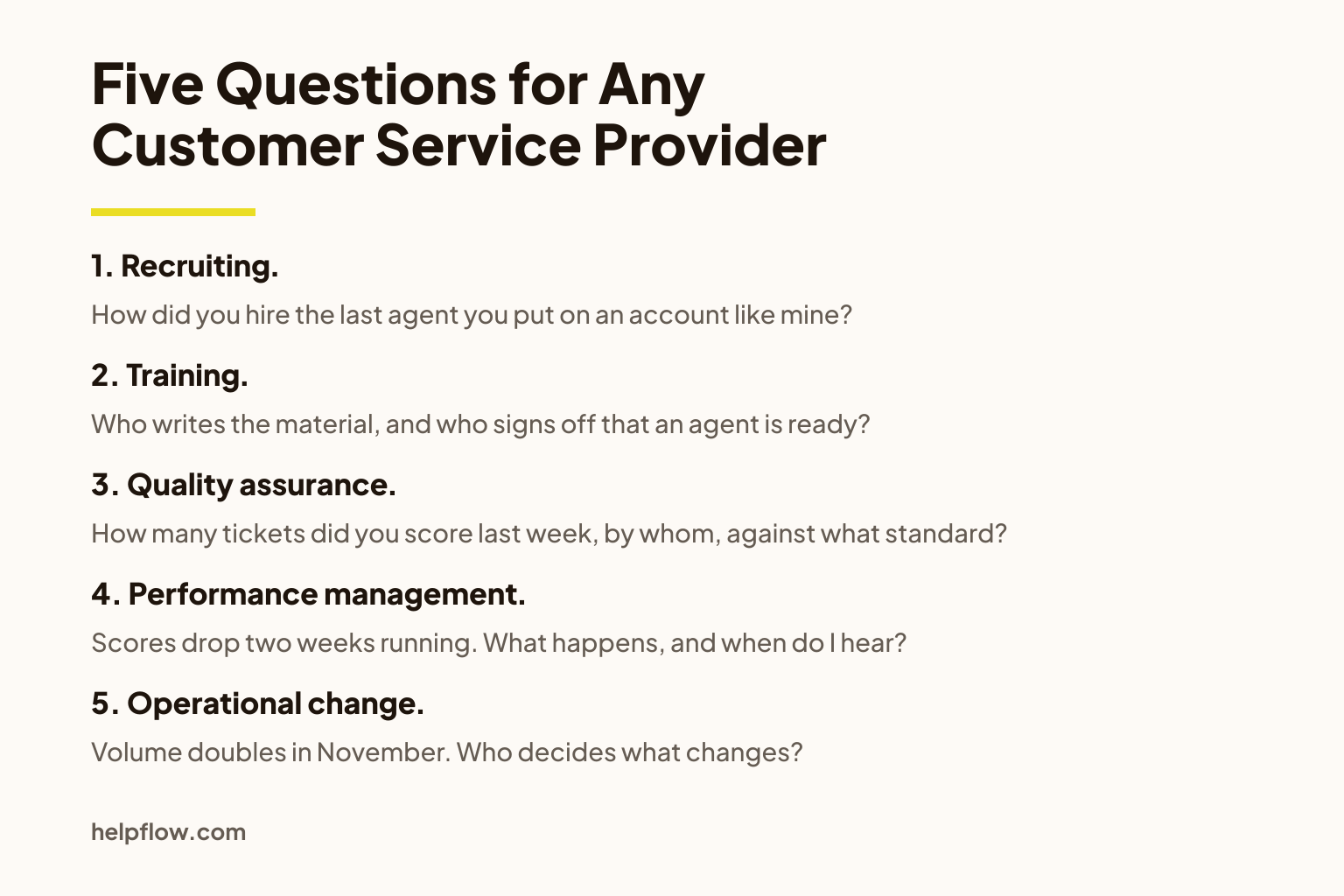
- Recruiting. “Walk me through how you hired the last agent you put on an account like mine. Who screened them, what was the test, and how long did it take?”
- Training. “What do the first two weeks look like for an agent on my account? Who writes the material, and who signs off that they’re ready to answer a real customer?”
- Quality assurance. “Show me a scorecard somebody filled in last week on another account, with the client details removed. How many tickets, scored by whom, against what standard?”
- Performance management. “An agent’s scores drop two weeks running. Tell me what happens, who does it, and at what point I hear about it.”
- Operational change. “I add a product line in November and volume doubles. Who decides what changes in the operation, and what do they change?”
Write the answers down next to the rate. An owned job comes back with a name attached and a document behind it. An unowned job comes back as a description of a capability.
Where HelpFlow Sits
Other agencies supply agents. HelpFlow supplies the managed customer service operation, which means all five jobs sit with us. We recruit and hire the agents, then train them on your products and policies. Every week we score their work against a written standard. We manage performance when it slips, and we rebuild how the operation runs when your business changes.
We run customer service operations for 100+ ecommerce brands, and clients average a 43% lift in first response time.
That includes businesses selling to consumers and businesses selling to other businesses, where a support conversation carries a PO number and a freight quote. The five jobs are the same either way, and so is what happens when one of them has no owner.
Run the Test on Both Quotes
Take the five jobs into your next provider call. For each one, ask who owns it after you sign and what evidence exists that they’re doing it. Do it with both quotes in front of you.
Put the answers side by side. If one provider names a person and a frequency for all five while the other names them for two, the remaining three land back on you, and that gap is worth more than the difference in the rate. You can see it now instead of in February.
If you’d rather hand over all five, that’s the operation we run.
Stop Running Customer Service Yourself
HelpFlow runs managed customer service operations for ecommerce businesses. We handle recruiting, training, QA, and performance management. Book fifteen minutes and we'll map your volume and your gaps.