
Support for Customers Who Buy on Credit Terms
A reply to a commercial customer can be fast, friendly, and wrong against their terms. Four checks that catch it, and one you can run on your queue this week.

A buyer at a restaurant group emails on a Tuesday morning to drop the fryer oil from this week’s standing order. Your team confirms the change within minutes and gets a five-star rating back. The order was picked and loaded the night before.
The oil arrives with the rest of the delivery, and the buyer finds out the reply was wrong when the invoice bills for it weeks later. Every number on your support scoreboard recorded that contact as a good one.
When your customer buys on credit terms, a support contact is usually a change to a commercial relationship, and the right answer depends on terms the person replying has to know. Your response time and satisfaction scores measure the reply. For commercial customers you also need to check whether the answer matched their terms and whether the thing the reply promised actually happened. That holds whether they’re your whole business or the stockists and retail partners who write into the same inbox as your consumer customers.
What a Commercial Customer Is Asking For
A contact from a commercial customer asks you to change something in a relationship that has terms attached. Some days the buyer wants to change a quantity on a purchase order or get a quote for a job. Other days they’re disputing a line on an invoice, filing a freight damage claim, or asking what substitutes for a backordered item.
At a commercial furniture supplier, that’s a facilities manager moving the delivery date on a signed order for task chairs, or a contractor asking whether a discontinued desk finish can be swapped on an office build-out. At a skincare brand that sells mostly to consumers, it’s a boutique that stocks the line emailing the same support address to reorder at its wholesale price, or to ask why its last shipment billed freight.
The right answer to each of those depends on the customer’s terms. That means their contract pricing, freight terms, and payment terms. It also means their tax-exempt status and who on their side is authorized to place or change an order. The person replying has to know those terms or look them up, and when neither happens the answer comes from the policy you apply to everyone else.
When that knowledge lives with the one person who remembers each customer’s negotiated terms, it leaves when they do.
A mistake in a reply to a commercial customer surfaces late. It shows up weeks afterward on an invoice or in a reorder that never comes. By then nobody connects it to a reply that scored well.

The same customer writes again next month and next year, so each wrong answer carries into the next order. A customer who keeps getting wrong invoices has a reason to price out another supplier.
What Your Support Scoreboard Measures
First response time, handle time, tickets closed, and the satisfaction rating on each ticket all measure the reply. Between them they tell you how fast it came and how the customer felt reading it. For a consumer with one order and one question, those are the right things to measure, because the reply is most of the service they receive.
A support contact from a commercial customer has a second half that happens after the reply. The reply confirms what they asked for. The service arrives later, when the warehouse picks the order, the invoice goes out, or the carrier settles a freight claim.
That’s how the scoreboard reads green while a commercial customer is served wrong. A fast, friendly, five-star reply that quoted list price to a contract customer scores well on every number you have. So does a reply that confirmed a quantity change after the order was picked.
We argued in 2021 that support metrics need segmenting by channel and by ticket type before they tell you anything useful. Who the customer is belongs on that list too. Report contacts from commercial customers separately from consumer contacts, and hold them to a standard that includes what happened after the reply. If you run a CS team scorecard, give commercial customers their own line on it.
Four Checks That Catch the Wrong Answer
The fix is in what your operation checks. Each of these catches a different kind of wrong answer, and each one needs someone to set it up and keep it running.
QA against the Customer’s Terms
Your QA rubric for a reply to a commercial customer asks whether the price, freight, payment terms, and authorization in the reply matched the customer record. A rubric that scores tone and policy accuracy will pass a warm, complete reply that quoted list price to a customer on contract pricing. QA is what keeps support quality from drifting over time, and for commercial customers it has to score the reply against the terms.
Training on Commercial Policy
Your team learns your commercial policy, from credits and freight claims to backorder substitutions and who can authorize an order. A lab supply house gets an email from a researcher asking to add items to their department’s standing order. A trained person checks whether the researcher can authorize purchases and asks for a PO from purchasing before confirming anything. An untrained one confirms the change, and the department’s accounts payable team rejects the invoice.
Routing Commercial Customers to Someone Who Can See Their Terms
Contacts from commercial customers reach someone who has the customer’s terms on screen when they reply. At the skincare brand, the boutique’s reorder goes to the person who can see its wholesale price and payment terms. In the consumer queue, the same email gets answered from the retail macro, so the reply confirms the reorder at the retail price. Weeks later the boutique’s invoice bills every jar at that price, and its owner is the one who catches it.

Follow-Through on Order Changes, Credits, and Claims
A few contact types are finished only when something happens after the reply. Someone goes back to those contacts a few days later to confirm that the warehouse has the change, the credit memo posted, and the carrier has the freight claim. A follow-through on the restaurant group’s change would have found the fryer oil already on the truck, in time to correct the invoice before the buyer saw it.
Speed still matters on these contacts. A fast reply tells you the customer was answered, and only the follow-through tells you it was answered correctly.
The Check to Run This Week
You can find out in one sitting whether your support is built for your commercial customers. You need your help desk, a list of those customers, and access to your order and invoicing records.
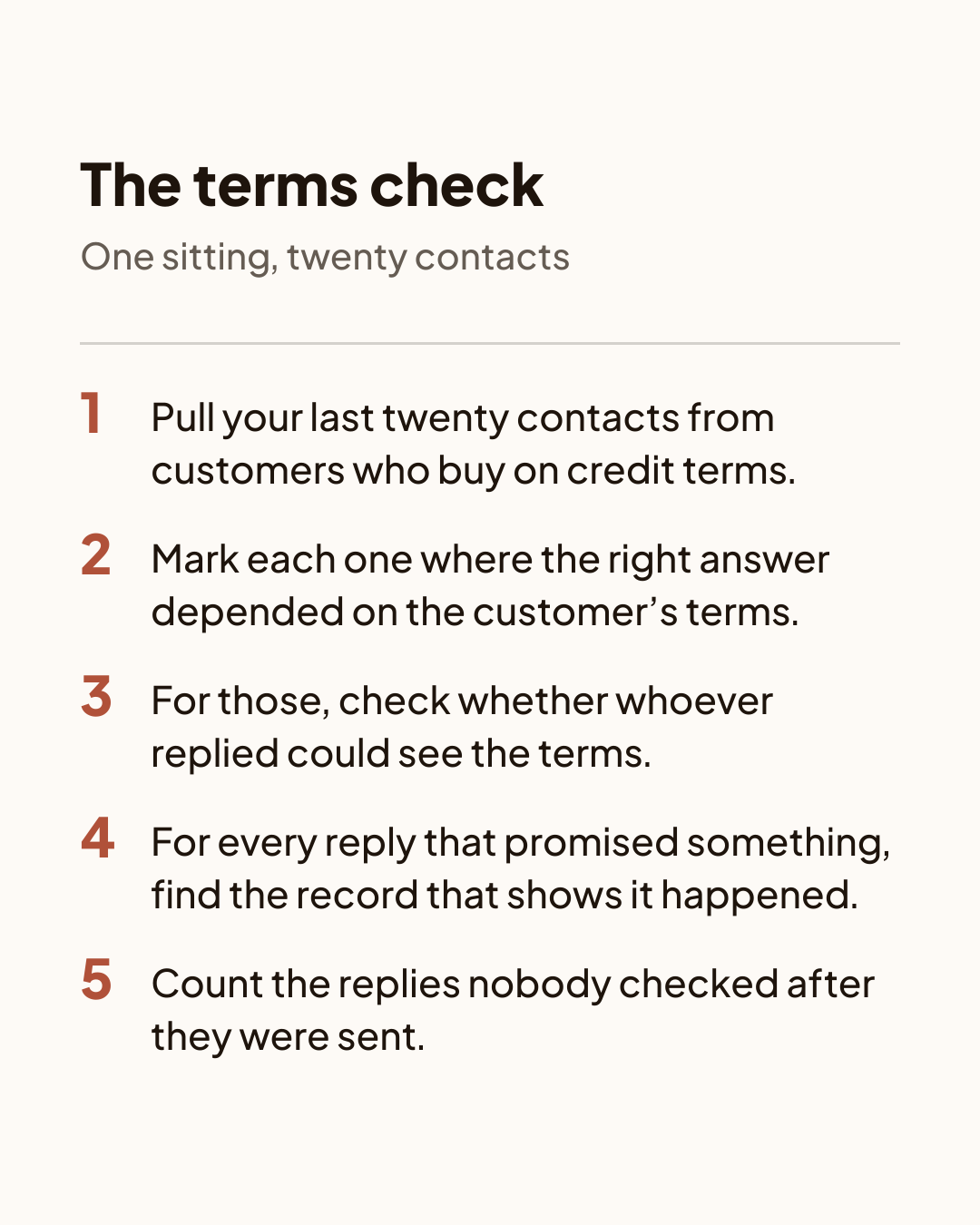
- Pull your last twenty contacts from customers who buy on credit terms. If they share an inbox with consumers, filter by those customers’ email domains.
- Mark each one where the right answer depended on the customer’s terms. Contract price, freight and payment terms, tax-exempt status, and ordering authority all count.
- For those, check whether whoever replied could see the terms. The terms should be in the help desk or one click from it, and a price sheet on someone’s desktop only counts for that one person.
- For every reply that promised something, find the record that shows it happened. Look for the amended order or the credit memo. For a freight claim you want the carrier’s confirmation, and for a substitution you want the packing slip.
- Count the replies nobody checked after they were sent. That number is your result.
Then reread those replies, starting with the ones sent to your largest customers, and note which of them you’d have written differently.
Who Builds and Runs These Checks
All four checks are standing work. Someone writes the QA criteria against each customer’s terms and trains each new hire on commercial policy. Someone keeps the routing current when a customer changes buyers, and someone runs the follow-through every week.
Other agencies supply agents who answer the reply. HelpFlow runs the whole support operation: recruiting, training, QA, and performance management. Building that operation around how your customers actually buy is part of the job. We’ve run customer service operations for 100+ ecommerce brands and handle 10K+ daily customer interactions.
Start with the twenty contacts this week. If the count is higher than you’d like, we can own those checks and run them every week as part of your support operation.
Stop Running Customer Service Yourself
HelpFlow runs managed customer service operations for ecommerce businesses. We handle recruiting, training, QA, and performance management. Book fifteen minutes and we'll map your volume and your gaps.