
What Leaves with Your Customer Service Provider
Leaving your support provider for an in-house hire or another agency decides who does five jobs. Why two clients came back to us, and a list to make first.

Whether you hire your own team or move to another agency, leaving a customer service provider decides who does five jobs. Every support agent depends on the same five:
- Recruiting
- Training
- QA
- Performance management
- Running the operation
A quote prices an agent and a salary prices a person, and neither tells you who will do the jobs around them.
Before you move, write down who does each job today and who will do it the day after. That list is the decision you’re making, and it’s worth seeing before you sign anything or post a job ad.
You might be treating the move as a staffing question, where a better person or a better agent makes support work again. The person matters a great deal, and the five jobs behind every agent decide whether a good person stays good after their first month.
When You Take Support In-House, All Five Jobs Are Yours
Hiring your own support person puts every one of the five jobs inside your business:
- You recruit the hire.
- Someone has to train them on your products and your policies.
- Someone reads their tickets and decides whether the work is good enough.
- Someone tells them when it falls short.
- Someone sets the schedule and covers the inbox when they’re out. When your business changes, someone changes how support works.
In a small team the support person often ends up doing most of that themselves, because they know the work better than anyone:
- They wrote the saved replies.
- They trained the part-timer who covers Saturdays.
- They know which tickets need you.
Everything holds while your support person stays. When they leave, you find out the operation was them. If your support person trained every part-timer you’ve had, nobody else can train the next hire. The weeks after a resignation are when all five jobs come back to you at once.

Picture a building-products company that sells online to contractors. Its support person answers order questions. Over the years they’ve also taken phone orders and prepared quotes. When that person gives notice, the owner inherits the five jobs and the order desk with them. The quotes contractors are waiting on now wait on the owner.
In-house works when someone in your business can run the operation, and can keep running it after the support person leaves. If that’s you or someone on your team, each of the five jobs has an owner. In-house then gives you direct control of every one of them.
When You Switch Agencies, You Get an Agent
Moving to another agency replaces the agent who answers your customers. Whether the five jobs move with that agent depends on the provider, and the answer is worth getting in writing before you sign.
If the agent arrives without the five jobs, a weak agent becomes the problem of whoever runs your support. Somebody has to notice the replies slipping and tell the agent what’s wrong. Somebody then decides whether to retrain them or ask the provider for someone new, and trains whoever arrives next. If that somebody is you, you’ve changed who answers the tickets and kept every job around them.
With a provider that takes all five jobs, the person who notices a weak agent and fixes the problem works for the provider rather than for you.
Clients Have Left HelpFlow, and Some Have Come Back
We’ve run customer service for ecommerce brands since 2015. Clients have left us in that time, and some have come back.
Two clients who came back did so because of a person. One took support in-house, and when the person it relied on left, it came back to HelpFlow. The other took support in-house and then moved to another provider. It wasn’t happy with the agent that provider gave it, and it came back to HelpFlow.
Your support person could leave next month, or your agent could stop working out. Who does the five jobs decides how much of that lands on you.
Other agencies supply agents. HelpFlow supplies the managed customer service operation, so all five jobs sit with us. We recruit and hire the agents, then train them and run QA on their work. We also manage their performance and run the operation itself.
List Who Does Each Job Before You Leave
Before you leave any provider, us included, write down the five jobs and put two names beside each one. The first name is whoever does that job today. The second is whoever will do it the day after you move.
Ask whoever runs your support today for the first list. Ask the provider you’re moving to for the second, or answer it yourself if you’re hiring.
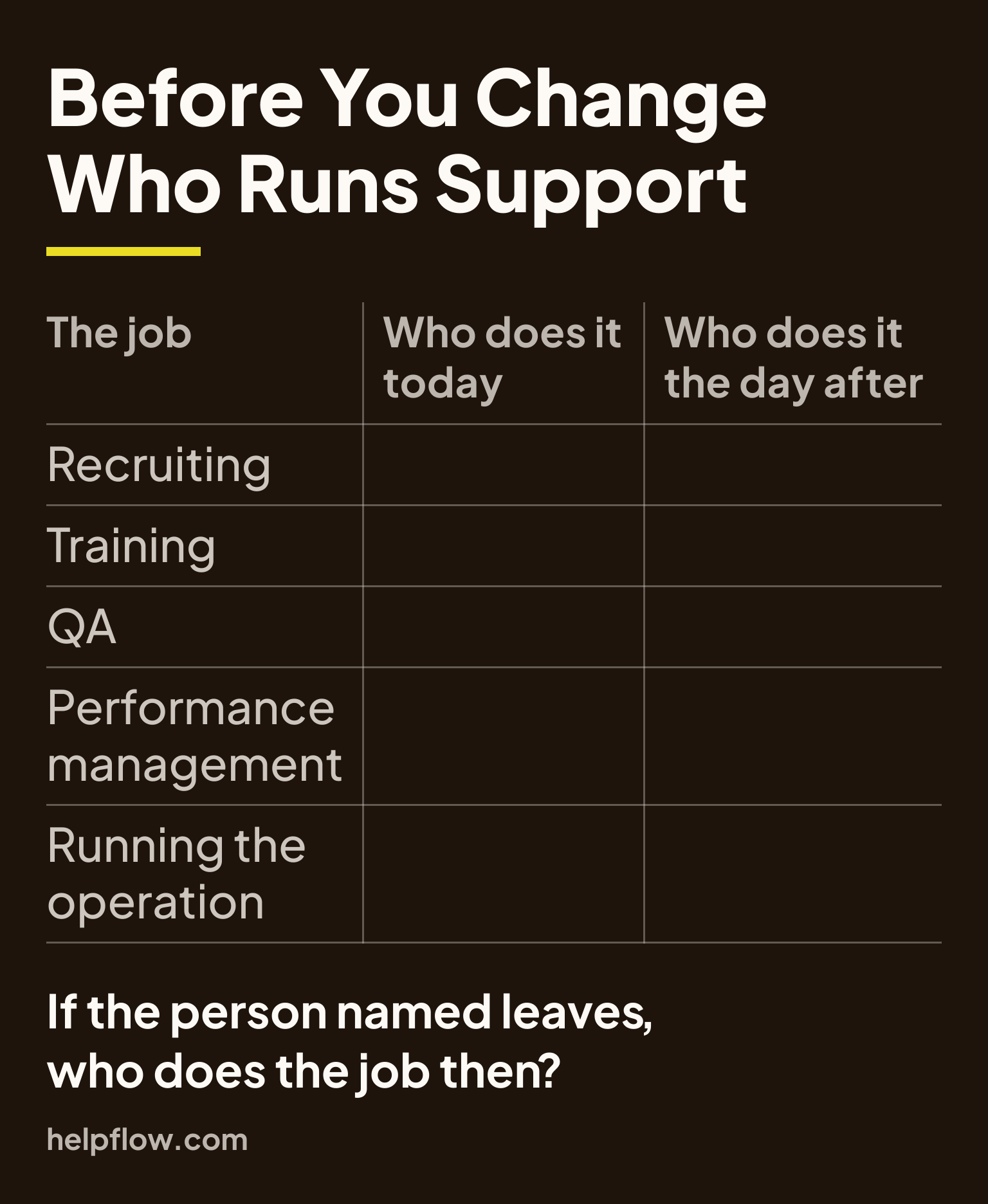
Then ask one more question of the second list. If the person named there leaves, who does the job then?
A name beside a job means the job has an owner. Where your own name appears, that’s a job you’re taking on, so decide now whether you have the hours for it. A blank row means the job will fall to whoever is nearest when something goes wrong. If the same name sits beside every job, your support operation is one person.
Stop Running Customer Service Yourself
HelpFlow runs managed customer service operations for ecommerce businesses. We handle recruiting, training, QA, and performance management. Book fifteen minutes and we'll map your volume and your gaps.