
Executive Assistant 2026 Delegation Map for CEOs
Unlock smarter delegation in 2026. Discover how an Executive Assistant helps CEOs focus on strategy by offloading the right tasks without losing control.

“You need to delegate more.” Every founder hears it. And most nod along—then keep doing everything themselves.
Not because they don’t want to let go but because it’s risky without a clear map. Offload the wrong thing? Quality drops. Hold on too long? Momentum stalls. Either way, you stay stuck in the weeds.
Here’s the truth for 2026: Delegation isn’t just a time-saver—it’s the difference between a business that scales and one that plateaus. Strategic delegation clears your headspace and unlocks compounding results. But only if you delegate the right things, the right way.
At HelpFlow, we’ve spent over a decade helping founder-led companies scale with Executive Assistant teams. This post breaks down a tactical Delegation Map you can use to decide what to own vs. offload—and how to empower your EA to execute without hand-holding.
Let’s get you out of the weeds and back into forward motion.

Executive Assistant Fix for Founder Bottlenecks
Most CEOs don’t avoid delegation because they’re control freaks.
They avoid it because they’re unclear on what to let go of—and what might break if they do.
This lack of clarity creates a bottleneck. You stay in the loop “just in case,” and suddenly everything runs through you. Decisions drag, execution slows and your team waits. Even experienced leaders get stuck here—not because they lack people, but because they haven’t mapped outcomes to ownership.
Here’s how the bottleneck shows up:
- You’re the default for everything. No one makes a move without your input.
- You’re buried in context-switching. Calls, emails, project tweaks—nonstop.
- You can’t unplug. Even quick breaks require a full handoff plan.
In founder-led companies, things get easier fast once leaders get strict on role clarity—what truly needs their judgment vs. what can run without them. That alone can free up 10+ hours a week, and it’s what makes an Executive Assistant actually effective.
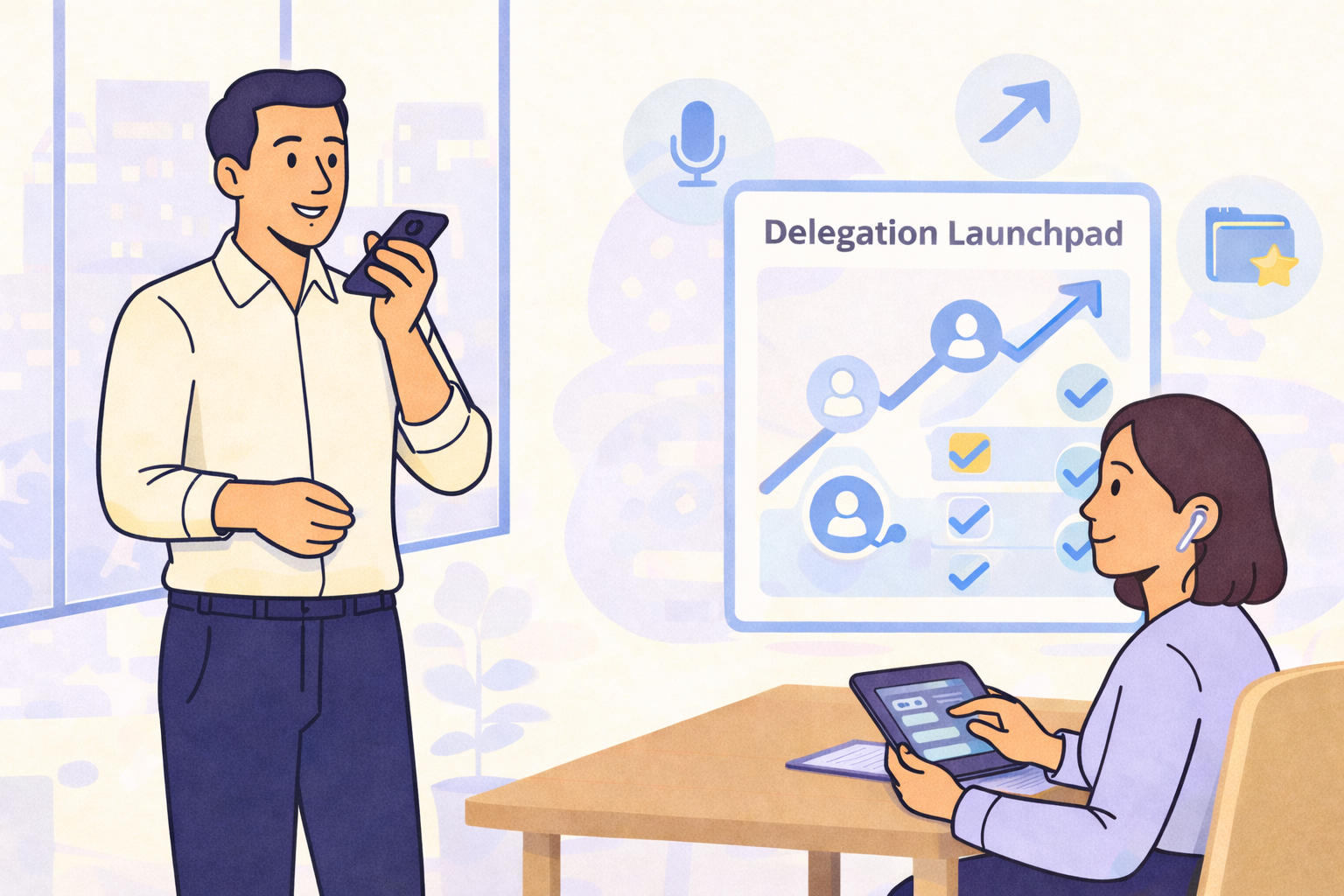
Executive Assistant 2026 Delegation Map for CEOs
Delegation gets easier when you see it through the right lens.
Use this simple 2x2 grid: Strategic vs. Tactical and Founder-Only vs. Delegate-Ready. It helps you figure out what truly needs you—and what an Executive Assistant or team can handle.
Here’s how to break it down:
- Delegate-Ready Tactical: Low-stakes, repeatable tasks. Think inbox triage, scheduling, meeting prep, CRM updates. These eat hours—but don’t need your brain.
- Delegate-Ready Strategic: Higher-value work that guides the business but can be systematized. Examples: pipeline follow-ups, drafting SOPs, internal reporting. You set the direction, your EA drives the output.
- Founder-Only Tactical: You’re still doing these—but you shouldn’t be. Think firefighting issues, patchwork solutions, or approvals that clog your day. These don’t need your brain but they do need structure.
- Founder-Only Strategic: This is your lane. Vision, key hires, investor convos—anything that moves the company forward in a big way. Stay here.
Don’t overthink this. Start by reviewing your calendar and to-dos from last week. Categorize each one using this grid. Then, identify 3–5 tasks you can offload immediately. Delegation doesn’t require a full playbook—it just needs structure. And with the right Executive Assistant, you’ll get that structure without losing speed.

How an Executive Assistant Executes Without Hand-Holding
Even with a clear delegation map, things fall apart if you’re still the middleman.
That’s where a trained Executive Assistant makes the difference—not just checking boxes, but owning outcomes. The goal isn’t to send your EA a task list every morning. It’s to build a system where they take action without waiting on you.
Here’s how that works:
-
Structured intake: Your EA doesn’t just “take notes.” They gather context, spot patterns, and build workflows around how you think.
-
Async communication: No endless back-and-forth. You record quick updates. They execute, ask smart questions, and close the loop.
-
Fast iterations: Delegation improves through reps. Your EA doesn’t need perfection—they need feedback. The more they run with tasks, the sharper their execution gets.
Add in AI copilots and internal quality checks, and now you’ve got an EA who can handle complex processes without constant oversight. They don’t just keep up—they push things forward. This is what separates “just a VA” from a true Executive Assistant: execution, without friction.
Delegate Smarter, Lead Better
When you know what to delegate—and have the right person to run with it—you unlock serious momentum.
A sharp Executive Assistant, paired with a clear delegation map, turns chaos into clarity—and gives you back the headspace to lead.
Want to put this into motion today?
Try our FREE Voice Note to SOP Generator GPT. Just speak your process, and it turns your voice note into a clean, ready-to-run SOP your EA can execute. No overthinking. No bottlenecks. Just forward motion.
Stop running customer service yourself.
HelpFlow runs managed customer service operations for e-commerce businesses — recruiting, training, QA, and performance management. Book fifteen minutes and we'll map your volume and your gaps.