
Complete guide: Managed eCommerce customer service operations
How modern DTC and multi-channel brands turn customer support from a cost center into a revenue, retention, and brand-differentiation engine.

The eCommerce landscape has never been more competitive. Brands compete on price, product, and speed — but the companies that consistently win long-term share one defining characteristic: they make every customer feel like a priority.
Customer support is no longer a cost center to be minimized. For modern eCommerce brands, it is a revenue driver, a retention engine, and a brand differentiator rolled into one. Yet most growing brands reach an inflection point where their in-house team can no longer keep pace: ticket volumes spike during peak seasons, response times suffer, and agents burn out trying to cover 24/7 demand.
This is where managed eCommerce customer support changes everything.
In this guide, HelpFlow — a leading managed eCommerce customer support provider — shares everything you need to know to transform your customer support from a reactive function into a proactive growth lever. Whether you’re a DTC brand doing $5M a year or a multi-channel retailer at $100M+, this guide will help you make smarter decisions about how you staff, scale, and optimize your customer support operation.

What is Managed eCommerce Customer Support?
Managed eCommerce customer support refers to outsourcing or co-sourcing your brand’s customer service function to a specialized partner — one that brings dedicated agents, proven processes, technology infrastructure, and deep eCommerce expertise to handle your customer interactions at scale.
Unlike generic BPO (Business Process Outsourcing) or offshore call centers, a managed eCommerce support partner is specifically designed for the nuances of online retail: order tracking, returns and exchanges, subscription management, fraud escalations, product FAQs, and much more.
The Three Models of eCommerce Customer Support
1. In-House Support
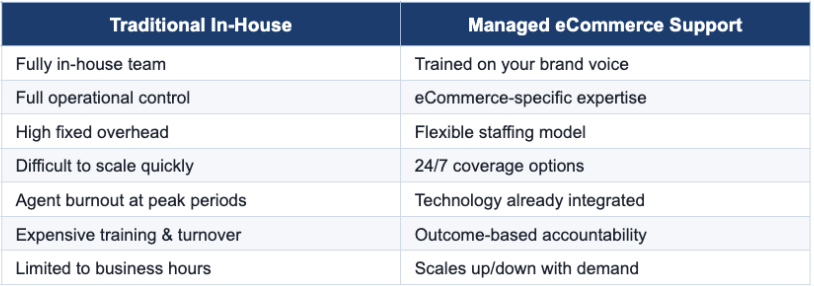
You hire, train, and manage your own team of customer service agents. You own the process, tools, and scheduling. This model works well at early stages but becomes increasingly difficult to scale affordably as ticket volumes grow.
2. Traditional BPO / Outsourcing
You hand off customer service to a large outsourcing firm. Cost is typically lower, but you often sacrifice brand voice, specialized knowledge, and quality control. Agents handle hundreds of different brands simultaneously, with little investment in your specific customer journey.
3. Managed eCommerce Customer Support (The HelpFlow Model)
A specialized partner that acts as a true extension of your team. Agents are trained specifically on your brand, products, and tone. They integrate with your tech stack (Shopify, Gorgias, Klaviyo, etc.), operate during your peak hours, and are measured by outcomes — not just ticket volume.
The Business Case: Why eCommerce Brands Are Making the Switch
The decision to partner with a managed customer support provider is ultimately a strategic and financial one. Here’s why leading brands are making the move — and the data that supports it.
1. The Hidden Cost of Poor Customer Support
Most brands underestimate the full cost of a bad customer experience. It’s not just the lost sale from a frustrated customer — it’s the ripple effect across your entire growth engine.
- 73% of customers will leave a brand after three or fewer negative experiences (PwC)
- A single bad experience can generate 15+ negative word-of-mouth mentions
- Returning customers spend 67% more than first-time buyers on average
- A 5% increase in retention rates can grow profits by 25–95% (Harvard Business Review)
When response times are slow, agent quality is inconsistent, or customers are left without resolution, the downstream impact on LTV (lifetime value), NPS (Net Promoter Score), and repeat purchase rate is severe.
2. The True Cost of In-House Staffing
Building and maintaining a high-quality in-house team is expensive — and the costs compound as you grow. Consider the fully-loaded cost of a single customer service representative:
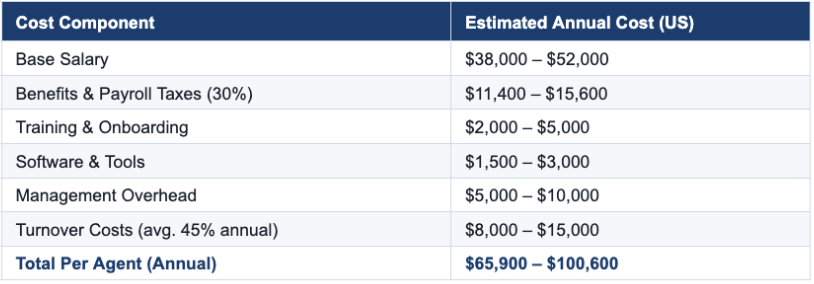
A managed partner typically reduces this cost by 40–60% while delivering higher consistency, since there’s no turnover disruption, no training gap during seasonal ramp-up, and no coverage gaps from callouts.
3. Revenue Recovery: The Often-Overlooked ROI of Great Support
Great customer support isn’t just defensive — it actively generates revenue. HelpFlow clients consistently see measurable lift in:
- Cart abandonment recovery through proactive chat outreach
- Upsell and cross-sell during support conversations
- Repeat purchase rates from resolved issues that turn detractors into promoters
- Reduced refund rates through faster, more satisfying resolutions

Core Components of a World-Class eCommerce Support Operation
Not all managed support is created equal. The best providers build their operations around five interconnected pillars that work together to drive consistent, scalable customer support outcomes.
Pillar 1: The Right People — Trained to Represent Your Brand
The quality of your customer support is ultimately determined by the people delivering it. Managed eCommerce support done right means agents who:
- Undergo deep brand immersion training — not just a 30-minute onboarding
- Understand your product catalog, policies, and most common customer questions
- Write and speak in your brand’s tone and voice
- Have genuine empathy and customer-first mindsets
- Are managed by leads who understand eCommerce metrics and expectations
HelpFlow’s agents are dedicated to specific clients, not shared across dozens of accounts. This means agents develop genuine product knowledge and brand fluency over time — something no generic BPO can replicate.
Pillar 2: Smart Processes — SOPs That Scale
Without documented processes, every agent interaction becomes improvised. World-class operations are built on Standard Operating Procedures (SOPs) that cover every possible customer scenario:
- Order status inquiries and fulfillment exceptions
- Returns, exchanges, and refund processing
- Subscription management (pause, skip, cancel, reactivate)
- Product defect and damage claims
- High-priority VIP and escalation handling
- Fraud and chargeback flagging
- Social media comment moderation and DM responses
HelpFlow builds custom SOP libraries for each client during onboarding and continuously refines them based on new ticket trends, policy changes, and seasonal insights.
Pillar 3: Technology — Integrated, Not Bolted On
eCommerce brands run on tech stacks. The right support partner doesn’t require you to change how you operate — they integrate seamlessly into what you already use.
Essential Integrations for eCommerce Support
- Gorgias, Zendesk, Freshdesk, Re:amaze Helpdesk Platforms:
- Shopify, BigCommerce, WooCommerce, Magento eCommerce Platforms:
- ShipStation, Shipbob, Brightpearl, Loop Returns Order Management:
- Klaviyo, Attentive, Postscript, HubSpot CRM & Email:
- Intercom, Tidio, Drift, Gorgias Chat Live Chat:
- Okendo, Yotpo, Stamped, Trustpilot Review Platforms:
When your support partner is natively integrated into these tools, agents can resolve tickets faster, with better context — and your operations data stays clean and centralized.
Pillar 4: Coverage — When and Where Your Customers Need You
Customer expectations have evolved. Today’s shoppers expect responses within hours — not days. And with international audiences, 24/7 coverage is no longer a luxury; it’s table stakes.
A managed partner handles the coverage problem you simply can’t solve affordably in-house: covering evenings, weekends, holidays, and peak seasons without doubling your headcount.
Coverage Options to Look For:
- Extended hours (8am–midnight coverage, 7 days/week)
- True 24/7 support for global brands
- Overflow support for peak seasons (BFCM, holiday, product launches)
- Live chat coverage during high-traffic windows
- Social media monitoring and response during off-hours
Pillar 5: Reporting & Continuous Improvement
What gets measured gets improved. The best managed support partners don’t just close tickets — they deliver insights that make your entire operation smarter.
Key Metrics to Track
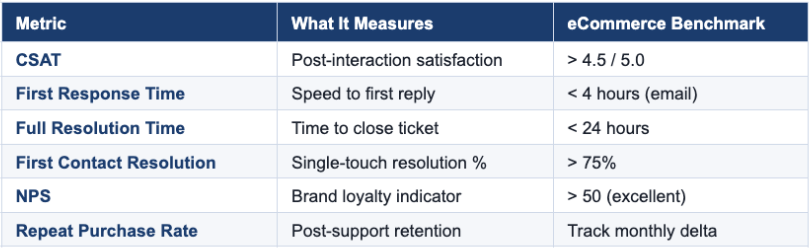
- Average time to first reply after ticket submission First Response Time (FRT)
- Time from open to closed/resolved Full Resolution Time (FRT)
- Post-interaction survey rating Customer Satisfaction Score (CSAT)
- % of tickets resolved without escalation First Contact Resolution Rate (FCR)
- What issues are customers contacting you about? Ticket Volume by Category
- Internal QA assessment of response quality Agent Quality Score
- How many issues are resolved via self-service? Deflection Rate

How to Choose the Right Managed Support Partner: 10 Critical Questions
Not every managed support provider is equipped to handle eCommerce at scale. Before signing a contract, ask these ten questions — and push for specific, evidence-backed answers.
-
Q1: Do you specialize in eCommerce, or do you serve all industries equally?
Specialization matters. An eCommerce-focused partner understands Shopify’s order API, knows how to handle WISMO (Where Is My Order?) tickets at volume, and has seen every type of returns scenario imaginable. A generic BPO has none of this institutional knowledge. -
Q2: How do you onboard and train agents on my brand?
Ask for a sample onboarding timeline and training curriculum. Look for dedicated agents (not shared pools), brand immersion sessions, and written SOP development. Red flag: “agents will be ready in 48 hours.” -
Q3: How do you ensure quality at scale?
Request their QA methodology. Look for ticket sampling processes, scoring rubrics, peer review systems, and how frequently calibration sessions are held between your team and theirs. -
Q4: What does your reporting look like, and how often?
Ask to see a sample report. Look for ticket volume trends, CSAT scores, FRT, FCR, and category breakdowns. Bi-weekly or monthly check-ins with a named account manager signal a real partnership. -
Q5: How do you handle peak season surges?
BFCM, holiday, and product launches create volume spikes that can break a support operation. Ask how many agents they can flex up, how quickly, and what lead time they need from you. -
Q6: What is your agent turnover rate?
High turnover is the enemy of brand consistency. Ask for their annual retention rate. HelpFlow maintains above-average retention by investing in agent career development, competitive pay, and a culture that values customer support excellence. -
Q7: How do you handle escalations?
Who decides when an issue escalates to your internal team? Is there a clear protocol? Can you define your own escalation triggers? A well-designed escalation path is a sign of operational maturity. -
Q8: What technology do you support natively?
Confirm compatibility with your existing stack. A great partner shouldn’t require you to switch helpdesks or add-on tools just to work with them. -
Q9: Can I speak with current clients in my category?
References are non-negotiable for a partnership of this magnitude. Ask for 2–3 references from brands of similar size and category. Bonus points if they’ll connect you with a client who went through a challenging ramp-up. -
Q10: What does the contract structure look like?
Understand pricing models (per ticket vs. per agent vs. retainer), minimum commitments, flex pricing during peak season, and exit clauses. A confident partner stands behind their results.
The HelpFlow Approach: What Sets Us Apart
HelpFlow was founded with a singular mission: to help eCommerce brands deliver customer experiences so good that they become a genuine competitive advantage. Here’s how we do it differently.
Dedicated Agent Teams, Not Shared Pools
Every HelpFlow client has a dedicated team of agents who work exclusively on their brand. This isn’t a staffing pool where agents rotate between accounts. Your agents know your products inside and out, they know your common customer personas, and they know your brand voice — because they live it every day.
eCommerce-Native from Day One
Our entire operation is built around eCommerce. Our training programs, our SOPs, our tech integrations, our reporting dashboards — all of it is designed for brands selling physical goods online. We don’t try to adapt a generic call center framework to your business. We built ours specifically for businesses like yours.
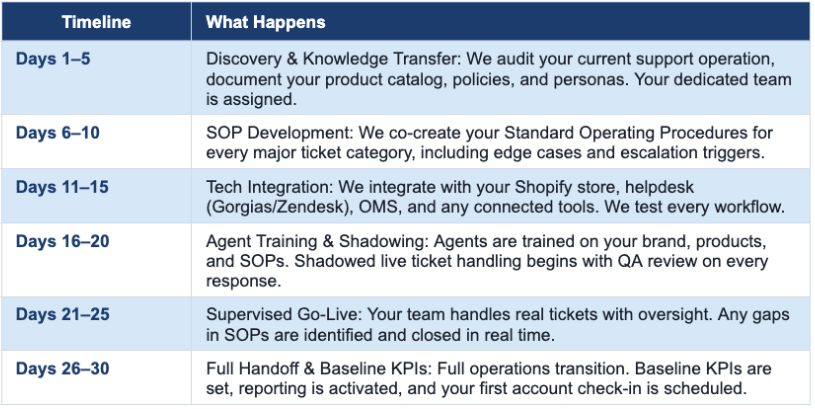
The HelpFlow Ramp: A 30-Day Onboarding Sprint
We don’t believe in slow, painful implementations. Our structured 30-day onboarding sprint gets your dedicated team operational, trained, and delivering results faster than any competitor.
Revenue-Positive Support: Our Core Philosophy
At HelpFlow, we believe customer support should pay for itself. Every interaction is an opportunity — to retain a customer who was about to churn, to convert a browser who was almost ready to buy, to strengthen the relationship with a loyal repeat purchaser.
Our agents are trained not just to resolve issues, but to identify and act on these revenue-positive moments — with the right guardrails to ensure it never feels pushy or transactional.
Transparent, Partnership-Level Reporting
We don’t hide behind aggregate stats. Every client gets access to:
- A real-time reporting dashboard with live ticket metrics
- Weekly Customer Support Insights Reports with category breakdowns and trend analysis
- Monthly QA score reports with individual agent performance
- Quarterly Business Reviews (QBRs) with your dedicated account manager
- Proactive alerts when volume spikes or quality dips unexpectedly
eCommerce Support Channels: Which Ones You Need (and When)
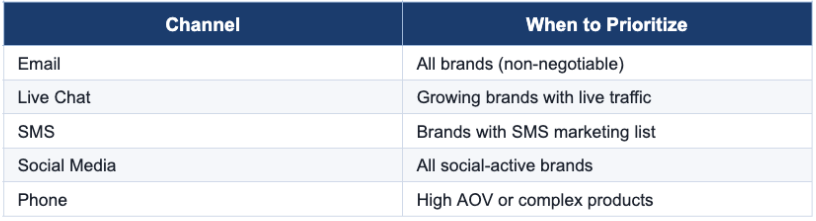
Modern eCommerce customers expect support on their terms — through whatever channel they’re using at that moment. A multi-channel support strategy is essential, but not every brand needs every channel from day one. Here’s how to think about prioritization.
Email / Helpdesk (Non-Negotiable)
Email remains the highest-volume channel for most eCommerce brands. It’s asynchronous, searchable, and creates a paper trail — essential for order disputes, refunds, and policy communications. Every brand needs a professional helpdesk setup with organized queues, macros, and automated triage.
Live Chat (High ROI for Growing Brands)
Live chat has among the highest customer satisfaction ratings of any support channel (73% satisfaction rate vs. 61% for email, per Forrester). For eCommerce brands, it’s particularly powerful for:
- Pre-purchase questions that remove buying friction
- Cart abandonment recovery in real time
- Upsell opportunities during the consideration phase
- Immediate order issue resolution that prevents chargebacks
The barrier for many brands is staffing live chat consistently. HelpFlow covers live chat during agreed peak hours so you get the conversion benefit without the operational headache.
SMS / Text Support (Emerging, High-Engagement)
SMS has a 98% open rate — far higher than email. Brands using SMS for support see faster resolutions and higher satisfaction scores. It’s particularly effective for order status updates, delivery notifications, and proactive outreach on known fulfillment delays.
Social Media (Brand-Critical)
Social media comments and DMs are public-facing support interactions. A slow, defensive, or unhelpful response can damage your brand with an audience of thousands. A fast, empathetic, on-brand response becomes a brand-building moment.
HelpFlow manages social media comment moderation and DM response for clients on Instagram, Facebook, TikTok, and Twitter/X — ensuring your public-facing customer support is always on point.
Phone / Voice Support (Situational)
Phone support is essential for high-AOV brands, complex subscription products, or audiences that skew older and prefer voice. It’s the highest-cost channel per interaction but creates the strongest emotional connection and is most effective for de-escalating angry customers.
Seasonal Scaling: Surviving (and Thriving During) Peak Periods
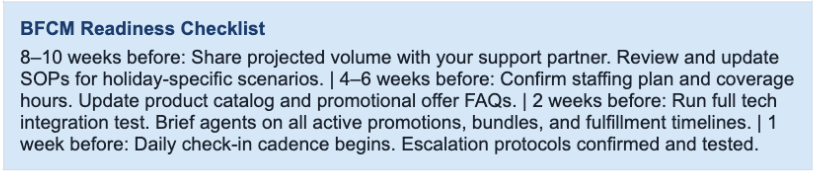
For eCommerce brands, peak seasons are make-or-break moments. Black Friday / Cyber Monday, the holiday shopping season, Valentine’s Day, Mother’s Day, and major product launches can produce 3–5× normal ticket volumes in a matter of days.
The brands that emerge from these periods with their reputation intact — and stronger customer relationships — are the ones that plan for scale before they need it.
Why Peak Season Support Breaks In-House Teams
- Hiring and training temporary agents takes 4–6 weeks minimum
- Seasonal hires have no brand knowledge and require significant oversight
- Overtime costs spike dramatically for existing staff
- Burnout leads to quality degradation exactly when stakes are highest
- After peak season, overstaffing creates excess cost
The Managed Partner Advantage During Peak
A managed partner like HelpFlow can flex agent capacity up by 50–200% in advance of peak periods because:
- We maintain a trained bench of agents across multiple client brands
- Our agents are already trained on your brand from day-to-day operations
- Our SOPs are built to cover surge scenarios (bulk order delays, inventory issues, high return volumes)
- We work with you 8–12 weeks in advance to forecast volume and pre-staff appropriately
The Role of AI and Automation in eCommerce Support
AI and automation are transforming customer support — but the brands seeing the best results aren’t replacing human agents with bots. They’re using AI to make their human agents dramatically more effective.
Where AI Adds Genuine Value
- AI analyzes incoming tickets and automatically routes them to the right queue (returns vs. shipping vs. billing) — eliminating manual triage. Ticket Classification & Routing:
- AI surfaces the most relevant response templates based on ticket content, reducing handle time by 30–50%. Smart Macros & Suggested Replies:
- AI-powered chatbots can resolve simple FAQs (order status, return policy, store hours) without agent involvement — handling 20–40% of total volume for well-configured brands. Chatbot Deflection:
- AI flags frustrated or high-risk customers for priority routing before they escalate. Sentiment Analysis:
- AI serves self-service article links in real time during chat interactions, empowering customers to resolve simple issues themselves. Knowledge Base Suggestions:
Where AI Falls Short (And Humans Are Irreplaceable)
AI is powerful for routine, rule-based interactions. But it consistently underperforms when:
- Emotional nuance is required — an angry customer who needs to feel heard
- Issues are complex or multi-step (e.g., damaged order + refund + reorder coordination)
- Brand voice and relationship building are critical (VIP customers, loyalty members)
- Edge cases fall outside the training data or SOP — which happens constantly in eCommerce
The winning formula in 2025 and beyond is AI + human hybrid: let automation handle the repetitive, high-volume work, and let skilled human agents handle the complex, high-stakes moments that determine whether a customer stays or goes.
HelpFlow integrates AI automation tooling across our clients’ helpdesks while maintaining the human-first culture that drives CSAT and retention outcomes.
Building a Customer-Centric Culture That Scales
Technology and processes are table stakes. The brands that truly differentiate on customer support have built it into their company culture — and that culture must extend to every partner and vendor in their ecosystem, including their managed support team.
The Customer Support Culture Pillars
1. Customer Obsession as a Core Value
The best eCommerce brands treat every customer interaction as an investment in a long-term relationship, not a cost to be minimized. This mindset has to be modeled from leadership, embedded in hiring criteria, and reinforced through recognition and incentives.
2. Empowered Agents
Agents who can resolve issues without escalating every decision are dramatically more effective — and more satisfying to interact with. Build policies that allow agents to offer a refund, a replacement, or a goodwill discount without manager approval within defined parameters. Customers notice. And agents feel trusted.
3. Proactive Communication Over Reactive Fire-Fighting
The best support experiences happen before a customer has to reach out. Proactive shipping delay notifications, order confirmation details, and returns status updates dramatically reduce inbound ticket volume and improve satisfaction simultaneously.
4. Closing the Loop with Product and Operations
Your support team is a treasure trove of product feedback, UX issues, and operational gaps — if you’re listening. Build a feedback loop from support insights into your product, operations, and marketing teams. HelpFlow’s weekly insights reports are specifically designed to surface these patterns.
Metrics That Drive a Customer-Centric Operation
What you measure signals what you value. The right KPI mix creates alignment around customer outcomes rather than just efficiency.
Is Managed Support Right for Your Brand Right Now?
Managed eCommerce customer support is a powerful solution — but like all strategic decisions, timing and fit matter. Here’s a framework to help you assess whether now is the right time to make the move.
Signs You’ve Outgrown In-House Support
- Your team regularly misses first response time targets
- CSAT scores are below 4.2/5.0 or trending downward
- Agents are handling 100+ tickets per day with no bandwidth to spare
- You have no consistent coverage on evenings, weekends, or holidays
- Peak season creates genuine operational crisis each year
- You’re spending significant management time on support operations vs. strategy
- Ticket volume has grown faster than your ability to hire and train
Signs You’re Ready for HelpFlow Specifically
- You’re doing at least $3M+ in annual revenue (we scale from there into the hundreds of millions)
- You’re committed to customer support as a competitive differentiator, not just a cost to minimize
- You have enough ticket volume to justify dedicated agent capacity (typically 500+ tickets/month)
- You use Shopify, BigCommerce, or a comparable eCommerce platform
- You’re open to a true partnership model — sharing data, insights, and feedback bi-directionally
When to Wait
There are also situations where managed support isn’t the right fit yet:
- Pre-revenue or very early stage (< $1M ARR) — build internal processes first
- Extremely niche product with specialized technical support needs that requires deep engineering knowledge
- Your support volume is so low that a dedicated team isn’t cost-effective
In these cases, HelpFlow is happy to consult on building the right internal foundation — because we know that when you’re ready to scale, you’ll want a partner you already trust.
The Bottom Line: Support as Strategy
The most successful eCommerce brands of the next decade will be the ones that treat customer support not as a necessary cost, but as a strategic lever for growth, retention, and competitive differentiation.
Every ticket is a data point. Every resolution is a relationship investment. Every exceptional experience is a word-of-mouth moment waiting to happen.
Managed eCommerce customer support — done right — gives you the team, processes, technology, and insights to deliver those exceptional experiences at scale, every day, without burning out your internal team or breaking your budget.
HelpFlow has helped hundreds of eCommerce brands make this transformation. We’re built for this work — and we’re ready to help you build a customer experience that becomes one of your most powerful competitive advantages.
Ready to Transform Your eCommerce Support?
Book a free 30-minute Customer Support Audit with a HelpFlow strategist.
We’ll review your current support operation, identify your biggest gaps and opportunities, and show you exactly what a HelpFlow partnership would look like for your brand.
Want this kind of operating leverage on your desk?
HelpFlow runs managed customer support operations for ecommerce brands. Fifteen minutes on a call and we'll map your volume and gaps.